
AI is Going to Change Everything (Even if You Lose Money)
Understanding the lifecycles of transformative technologies

In an earlier post, I argued that venture investors are already doing history when they evaluate companies, and that the quality of their historical reasoning affects whether they make or lose money. The same problem shows up in another form when the subject is artificial intelligence. There are a lot of questions in circulation. Does the current investment in AI make sense, or is it a massive bubble? Will the firms leading in AI development hold durable advantage, or will the technology diffuse and commoditize? Will AI reorganize national security and technology, or be absorbed into existing arrangements? The questions cannot wait for future evidence, because decisions about what to build and fund and which policies to enact are being made now. Most of the answers in circulation are predictions about where AI is going, and predictions about the future are very hard.
The difficulty is that confident predictions about transformative technologies have a poor track record. Strategic bombing has definitively shaped modern military strategy, but its original theorists believed the doctrine would make ground war obsolete.1 Commercial supersonic flight was predicted to shrink the globe but proved economically unviable.2 The Segway, a personal mobility scooter invented in the early 2000s, had many proponents including Steve Jobs, who reportedly believed it as important as the personal computer.3 And more recently, blockchain was framed as a revolution in finance, governance, and trust but mostly produced speculation. Our reasoning about AI must begin from this base rate of failed predictions.
If prediction is unreliable, the alternative is to reason historically. This requires a precise understanding of what technology itself is, because the implicit definition you use will determine which historical comparisons are relevant. The word technology comes from the Greek techne, referring to craft, skill, and art. To the Greeks, techne was a practical, bounded capacity that allowed an individual to bring something into existence that nature would not have produced on its own. It was understood as a human attribute used to solve specific problems, carrying no expectation that it would reorganize the deep structure of society.4 Much contemporary discourse about AI rests, implicitly, on this older conception. It treats AI as an instrument that states and firms wield, more powerful than previous instruments but still essentially a tool whose effects can be governed by good policy.
Modern macro-historical frameworks suggest a radically different conception. In these views, technology is not merely a tool that humans use but a primary driving force of history. Technology divides history into distinct eras, each triggered and defined by a massive technological threshold, from the Agricultural Revolution to the Scientific Revolution.5 When a society crosses one of these thresholds, the new technology dictates a complete reorganization of its economic systems, political structures, and daily life. The historical record supports this deeper view. We periodize prehistory by material culture and define prehistory’s end by a technological threshold, the invention of writing. At certain pivotal moments, technology transcends being a mere instrument and dictates the trajectory of human development, including the trajectory of state power and the distribution of advantage among rivals.
For anyone reasoning about AI, this distinction is more than academic. If AI is a tool, the task is to use it well and prevent its misuse. If AI is a transformative technology of the second kind, the task is to understand how it will rearrange the industries and institutions around it, and to position accordingly.
Two academics, Bresnahan and Trajtenberg, formalized one way to think about these technologies in 1995 with their concept of general-purpose technologies, identifying a class of technologies that are pervasive across sectors, improve over time, and enable complementary innovations.6 The steam engine is canonical. It not only powered early steam trains but also made the factory system, urbanization, and new structures of labor relations possible. The list of technologies that plausibly meet these conditions is short, often including agriculture, written language, the printing press, electricity, and the computer. The shortness of the list is itself notable. A frequent historical outcome for any given technology is not transformation but absorption.
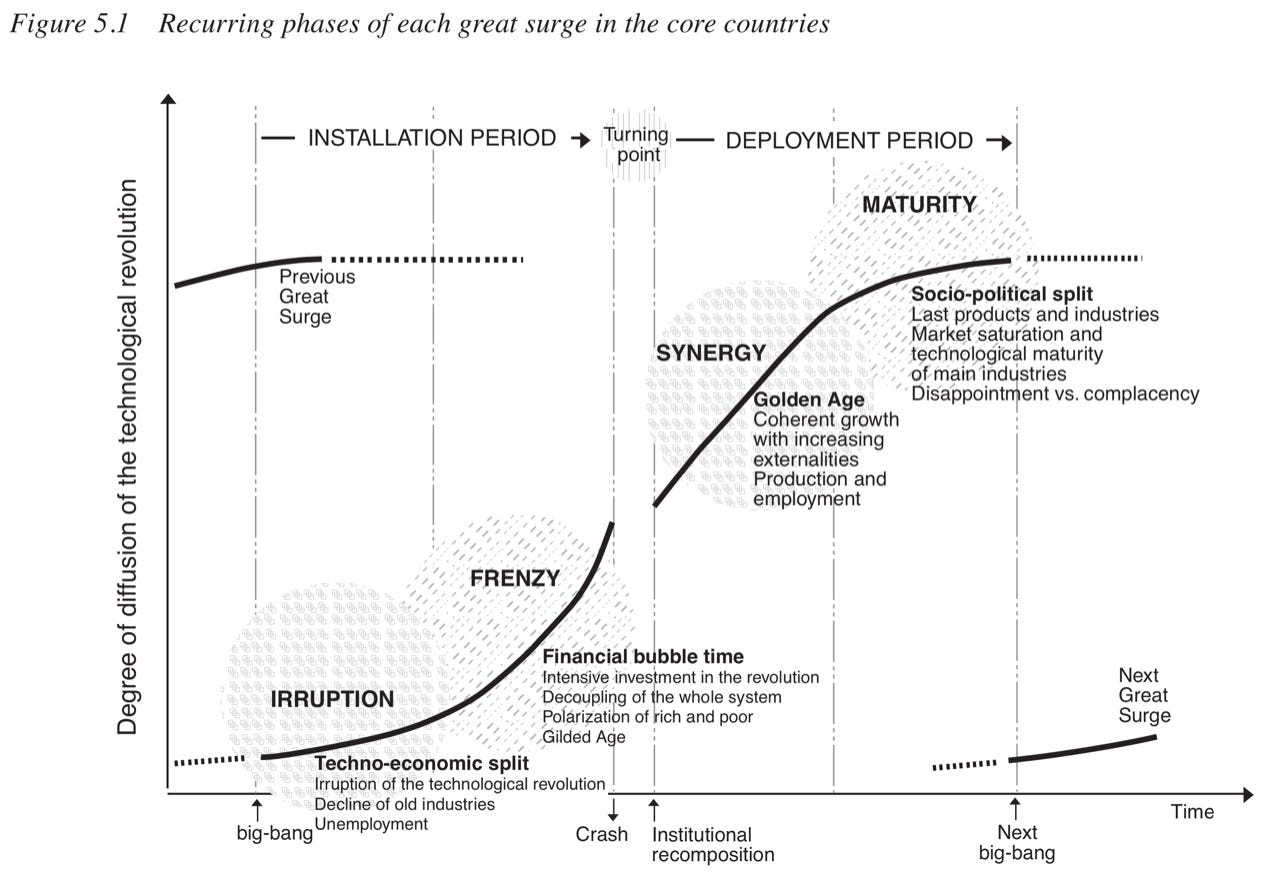
Carlota Perez’s work on technological revolutions and financial capital offers a complementary lens.7 Whereas Bresnahan and Trajtenberg identify which technologies have the structural capacity to be transformative, Perez describes how that transformation actually unfolds. In her account, every major technological revolution follows a recurring sequence: an installation phase driven by speculative financial capital, a crash or turning point when the bubble collapses, and a deployment phase in which institutions reorganize around the new technology. Railways, steel, electricity, and the automobile all followed this pattern. So, arguably, did the internet, whose dot-com bubble and subsequent institutional absorption fit the sequence closely. For policymakers, Perez’s framework matters because each phase produces different windows of strategic vulnerability and opportunity.
The two prior cases that rhyme most closely with AI are the printing press and the computer. The printing press reorganized how knowledge was produced and circulated in early modern Europe, and the institutions of religious and political authority eventually reorganized around it. This is a clear historical instance of a general-purpose technology changing a society over a long horizon. The computer is a more recent case, and the pattern holds. It transformed how information is produced, stored, and used, and the world has reorganized around this transformation for several decades. AI sits in this lineage, but where exactly is still an open question. Studying the printing press and the computer carefully helps us narrow the answer.
AI is almost certainly a transformative technology on the scale of the printing press and the computer. The historical record cannot tell us what the timeline will be, or who specifically captures the gains, or which firms are the Gutenbergs and which are the forgotten printers. It does say that this kind of technology, when it arrives, reshapes the industries and institutions around it. The reshaping is usually larger than the people living through the early years of it expected.
There were naysayers in the 1450s, and there are naysayers now. The naysayers in the 1450s were wrong, and looking back it seems obvious that they were wrong. Of course, the world of today is different from the world of the printing press and even the computer. How property rights work and how the scaling economics run are both worth their own piece. But the basic claim still holds. AI is the kind of technology that changes the world. Acting as though it is not is the more obviously foolish position of the two available.
Giulio Douhet et al., eds., The Command of the Air (University of Alabama Press, 2010).
Sachita Pandey, What Happened to the Concordes?, August 7, 2024, https://airandspace.si.edu/stories/editorial/what-happened-concordes.
John Heilemann, “Reinventing the Wheel,” Time, December 2, 2001, https://time.com/archive/6905012/reinventing-the-wheel-3/.
Joseph W. Slade and Leo Marx, “The Pilot and the Passenger: Essays on Literature, Technology, and Culture in the United States,” Technology and Culture 30, no. 4 (1989): n. The authors discuss both technology as “techne” but also as a revolutionary power., https://doi.org/10.2307/3106214.
Galen Strawson, “Sapiens: A Brief History of Humankind by Yuval Noah Harari – Review,” The Guardian, September 11, 2014, https://www.theguardian.com/books/2014/sep/11/sapiens-brief-history-humankind-yuval-noah-harari-review.
Timothy F. Bresnahan and M. Trajtenberg, “General Purpose Technologies ‘Engines of Growth’?,” Journal of Econometrics 65, no. 1 (1995): 83–108, https://doi.org/10.1016/0304-4076(94)01598-T.
C. Perez, Technological Revolutions and Financial Capital: The Dynamics of Bubbles and Golden Ages (Edward Elgar, 2011).