
How to Win a Defense Tech Hackathon
A practical guide to scoping, finding real users, and avoiding the trap of building too much.

I spent this past weekend helping organize and mentor at Critical Ops, the DC defense tech hackathon hosted by students from Johns Hopkins, Georgetown, and George Washington University. Over three days, hackers worked on problem sets pulled from real defense and intelligence challenges, with sponsors like OpenAI and Meta running a workshop on the floor. We had great judges including Justin Fanelli, CTO of the Navy, and James Mismash the DASW for Industrial Base Growth.
I want to share what I noticed from the mentor side, in case it helps anyone thinking about jumping into a defense tech hackathon.
The Vibe
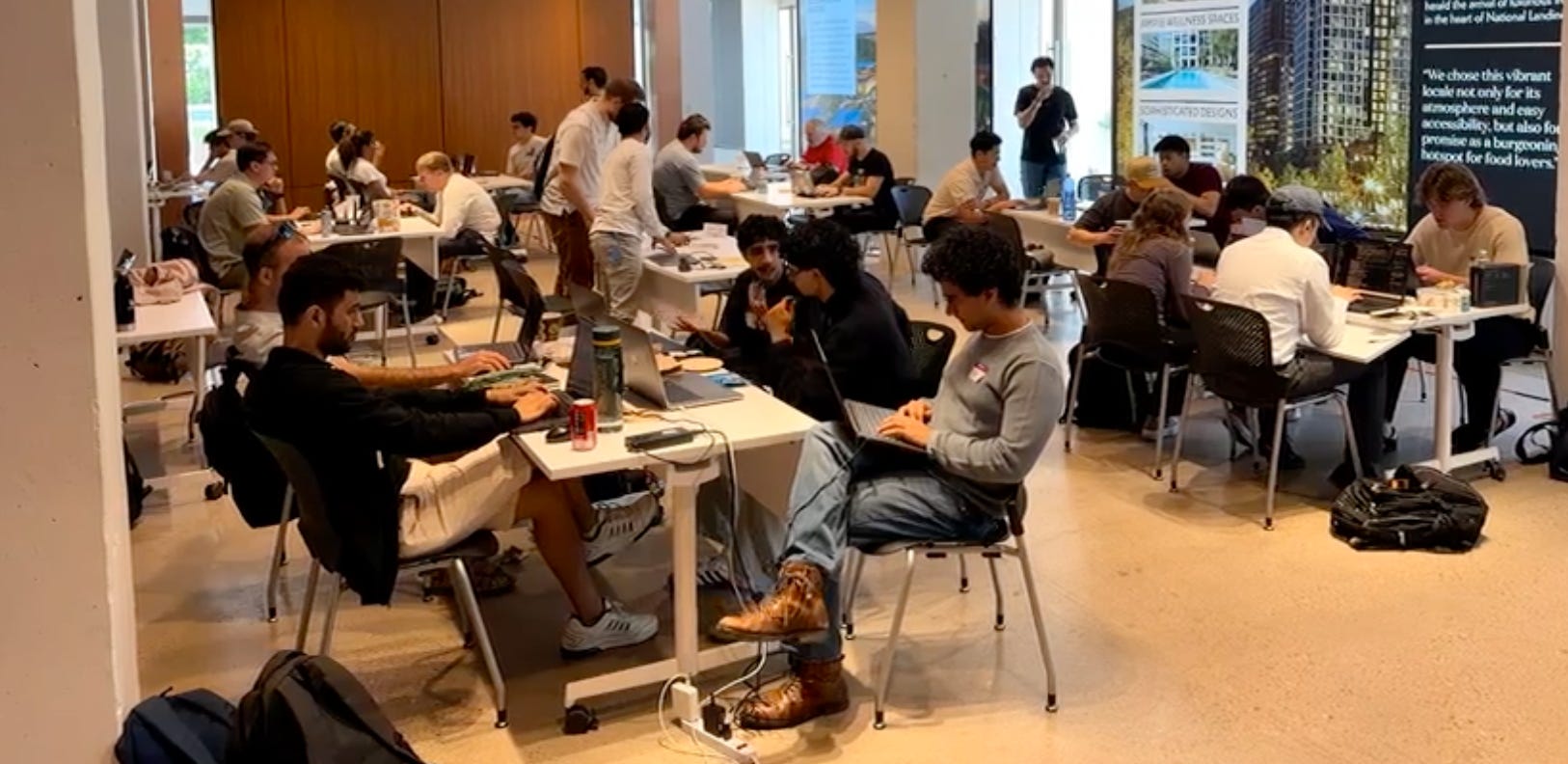
The energy in the room was high. People flew in for this as far as Iowa and California and stayed late into the night. It was a room full of people who genuinely wanted to build.
It is also worth noting how well the people without traditional coding backgrounds performed. Policy folks and military operators who had never written code simply paired up with engineers and started making things - or just worked without engineers at all, using Github for the first time. If you have stayed on the sidelines of defense tech because you assume you are not technical enough, the barrier to entry is lower than it seems.
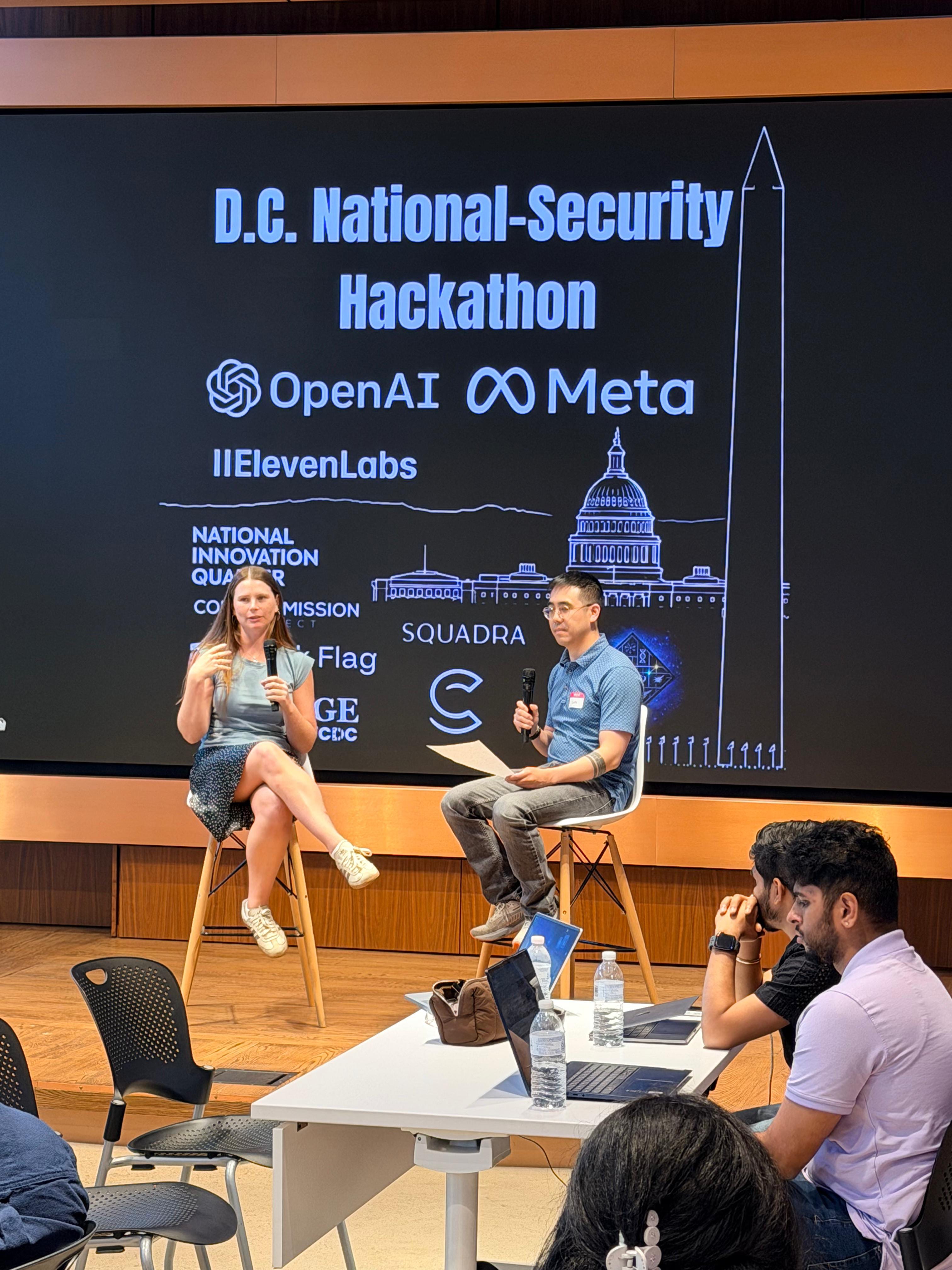
I had a chance to chat with Maggie Gray on stage before the hacking started, and her insights actually lined up quite well with what I saw over these three days.
What Teams Got Right
Use what is available: Teams that leaned hard on sponsor tools or open source instead of writing everything from scratch moved significantly faster. Using existing frameworks is good when you have limited time.
Anchoring to the problem statements: The organizers provided actual problem statements pulled from real defense and intelligence challenges. The teams that succeeded did not try to invent a new use case. They took those problem statements exactly as written and built directly toward what an end user was already asking for.
What Teams Got Wrong
Scoping too wide: Some teams had too many features, which was hard to explain in 3 minutes. Wiring up a new platform, a new model, and a new dashboard in 36 hours is a recipe for a broken Sunday demo. The version of your project that feels small is the right size for a weekend hackathon. The teams that cut their scope hard and early actually had working products by the end.
Vague users: Claiming a tool is built for the broader defense apparatus is probably too unspecific. Rather, think of who you are building for. Maggie Gray made this exact point on stage Friday. The teams that win are the ones who narrow down to a real person with a real problem before writing a single line of code.
Underutilizing the mentors: We had operators and engineers from startups as well as military veterans standing around specifically to help. Teams that asked thorough questions early saved themselves a lot of pain. Teams that waited until Sunday morning to surface their assumptions usually found out it was hard to pivot.
The Winners
🏆 ENEL (Edge-Network Environment Lattice) — Overall Winner
Akshay Akula, Puneet Velidi
Turning drone swarms into rapid 3D digital twin systems for mission planning and simulation
🥈 SeaForge — 2nd Place Overall + OpenAI Track Winner
Sabal Poudel, Vidur Kumar, Ziauddin Sherkar, Shashvath Srivatsa,
A software-defined ocean proving ground for autonomous maritime systems
🥉 JARVIS — 3rd Place Overall + ElevenLabs Track Winner
William Zhang, Richard Liu, Giulia Sheth, Sebastian D'Alessio
Resilient swarm coordination for contested, disconnected environments
🛡️ Guardian Angel — Meta Track Winner
Gema R., Ioannis N., Amar Zumkhawala
AI-powered mass casualty perception system for combat medics in the field.
Looking Ahead
If this kind of event is your speed and you missed Critical Ops, the 2026 National Security Hackathon is running their own defense tech hackathon in May that is worth keeping on your radar.

Huge thanks to everyone who showed up, built, mentored, sponsored, or judged! If you are thinking about doing one of these and have questions, my inbox is open.
Well done Luke! And awesome to see you and Maggie sharing a stage