
Parking is Strangling the Defense Industrial Base
Building the parking lot or the factory in LA

I recently saw one of the centers of gravity for the American defense industrial base, and it is alive with activity. The stretch of the LA metro running from El Segundo, through Long Beach, to Costa Mesa is home to a new generation of space and defense startups building hardware in a thriving ecosystem. The companies I visited had vast production floors literally humming with workers putting together satellites, massive rockets, and electrical parts as well as giant additive manufacturing machines.
One company was growing fast, but also experienced growing pains. An executive mentioned that they owned a plot of industrial land nearby and were thinking about building a multi-story parking structure on it to fix the parking problem. Apparently employees were overflowing parking into the neighboring localities and annoying the residents.
The parking commentary was striking. I don’t know the specifics of their situation, but the general tradeoff here seemed clear enough. In an expensive real estate market like the LA metro, land that could potentially be used for production instead gets used for storing cars, putting investor capital into a very expensive idle structure which generates no revenue at all.
I kept hearing about parking during other company tours. At some visits I asked about parking specifically, but at others, parking incidents just happened. At one company visit, a neighboring startup threatened to tow us for parking in their spot. Some companies had employees overflow parking to a nearby Whole Foods. At a food court frequented by aerospace workers, I found a t-shirt being sold that just said “I HATE PARKING IN LONG BEACH.”
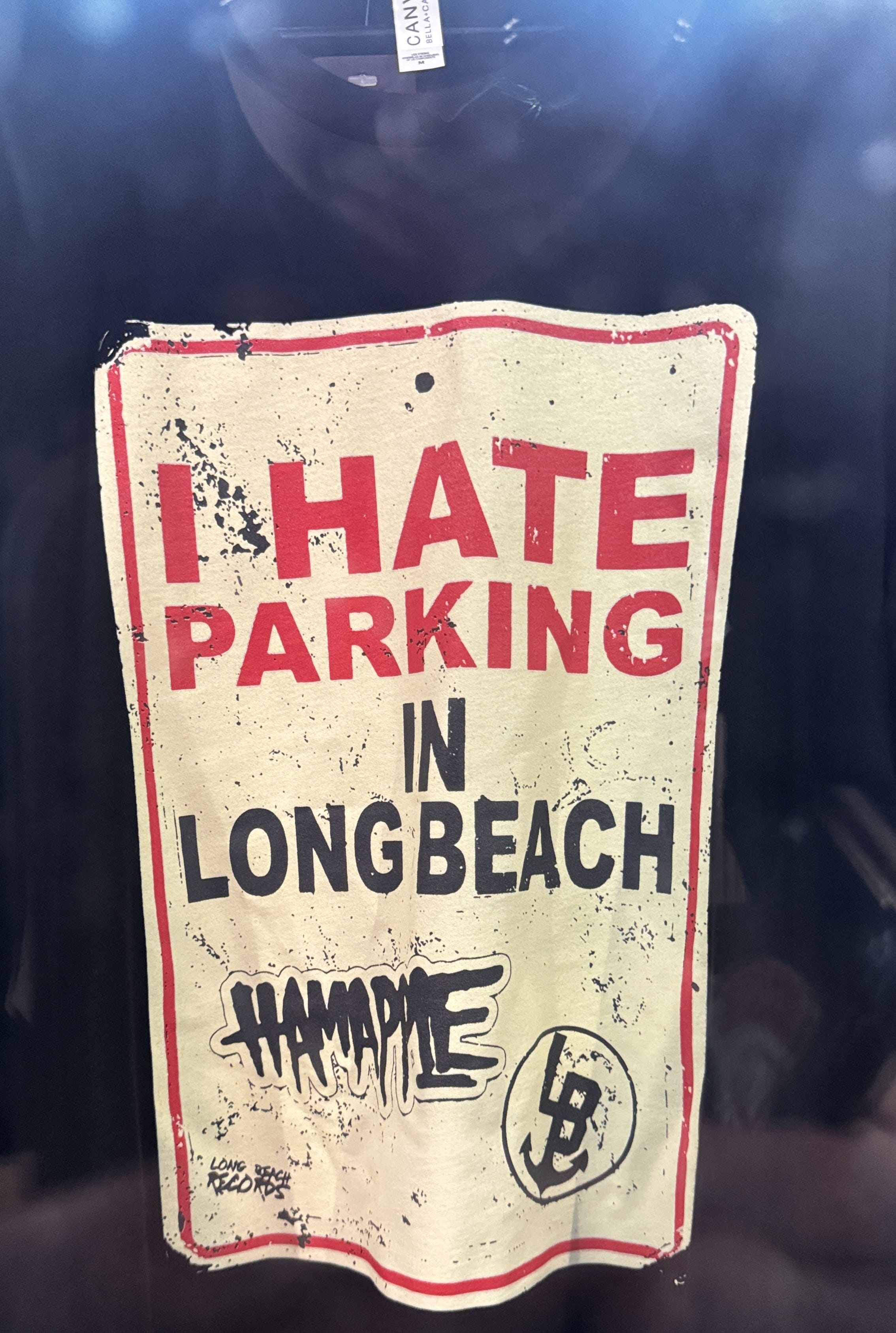
Parking problems, of course, are a daily fact of life for anyone who has lived in LA. A representative from the Long Beach mayor’s office put it simply: there’s so much growth happening, but people don’t have places to park. What do you do?
The discourse around American reindustrialization tends toward the big policy levers, things like acquisition reform, industrial policy, and military strategy. I do believe these things matter much more than parking. But underneath the policy debates, there’s a physical reality where companies actually have to put buildings and people somewhere, and that reality is shaped by decades of land use decisions and urban development patterns that people in the Pentagon don’t really mention at all (except when it’s about a lack of parking at the Pentagon).
So while parking is probably not *the* issue holding back the defense industrial base, it is a surprisingly high-impact constraint that almost nobody discusses because it seems too mundane to take seriously. I think it’s worth an investigation. Or, maybe I just wanted an excuse to write about parking and transit. I spent over a hundred dollars on Ubers on that trip and I’m still annoyed about it.
To understand why parking matters here specifically, you have to understand why this corridor became an aerospace capital in the first place.
The Power of Agglomeration
When I asked founders and executives what made LA special, their answers clustered around three things: talent, research, and suppliers.
The talent concentration in this corridor is unlike anywhere else in the country for aerospace work. Walking through these production floors, I saw electrical engineers, software developers, people working on reentry vehicles, even pharmaceutical researchers doing microgravity experiments. Everyone was building something related to space, and the companies employed thousands of people each.
This workforce didn’t appear out of nowhere. It traces back decades, to Howard Hughes founding Hughes Aircraft Company in 1932, which eventually became part of Raytheon and is now RTX. That was nearly a century ago, and the region has been accumulating aerospace expertise ever since. Spinoffs from one company seeded the next, especially from SpaceX.
The research ecosystem reinforces the talent pipeline. UCLA, Caltech, and UC Irvine are all within range (through LA traffic of course), producing engineers who can step into aerospace jobs without relocating across the country. Caltech in particular has deep historical ties to the industry, having fed engineers into aerospace companies since the early days of rocketry.
Then there are the suppliers. With so many specialized parts, machining services, and “vibe testing” facilities, this part of LA easily facilitates the manufacturing needs of companies building spacecraft. Economists call this an agglomeration effect, the same dynamic that explains why Hollywood dominates film production. You could theoretically build a rocket company in Iowa with cheap land, but you’d have to build the ecosystem around it from scratch, and that takes time you might not have if you’re trying to scale fast.
The problem is that this very concentration creates its own constraints if urban policy does not keep up. If the companies grow, which they quickly are in LA, the physical infrastructure must grow too. Though zoned for industrial use, the corridor from El Segundo through Long Beach to Costa Mesa is dealing with growing pains from parking.
The $15 Million Tradeoff
During my visit, the organizers had the foresight to arrange two vans to shuttle us between company sites. The shuttle saved us hours. But many employees drive themselves. Some of the companies we visited are growing by a hundred employees per month. Where do all those cars go? One employee wondered aloud whether they’d eventually need to bus workers in from remote lots, the way the old auto plants used to do.
One commercial real estate firm observes in El Segundo, “The problem in the district is the industrial buildings lack the parking space needed to conform to the city codes as office space or R&D space.”
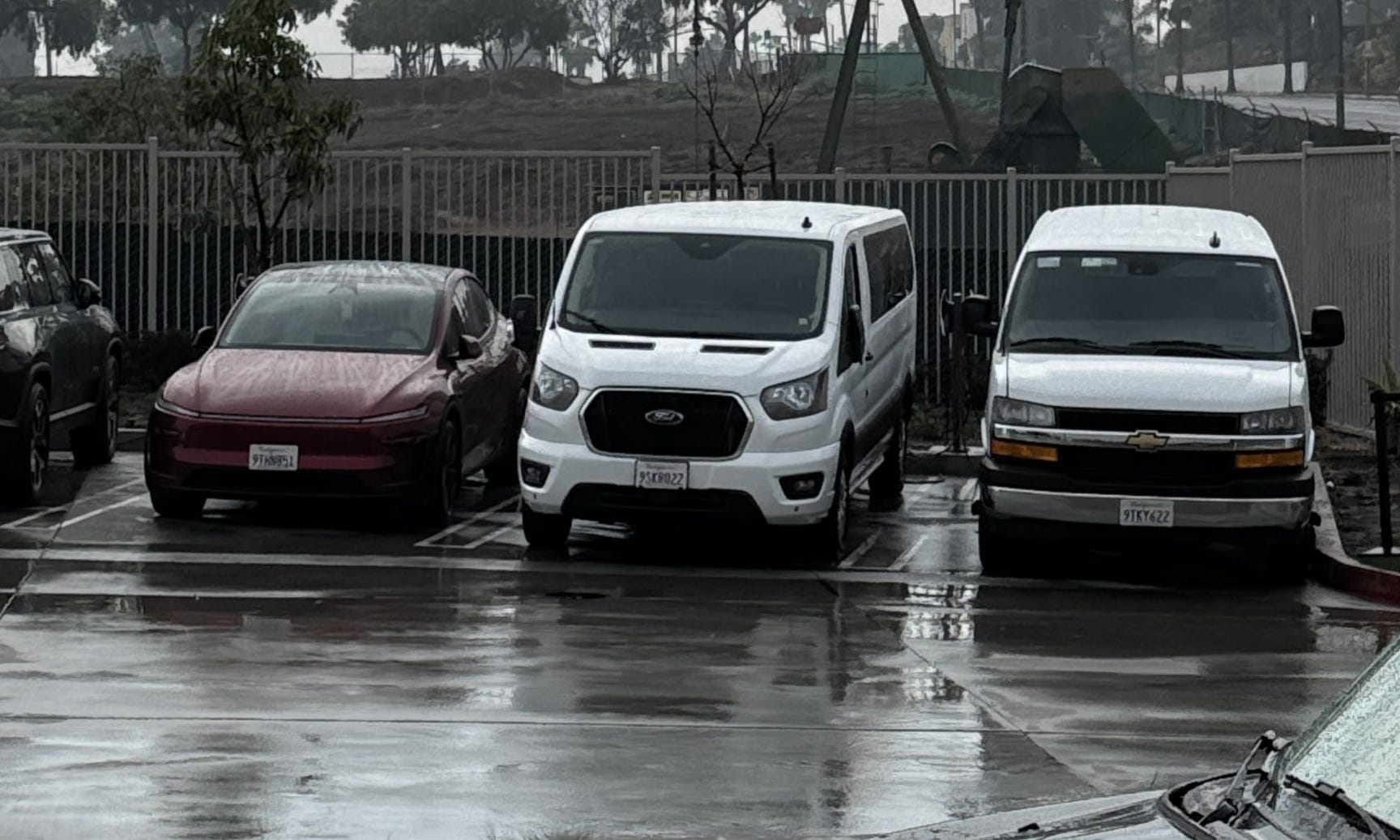
Companies facing this have a few initial options. They can let parking overflow and deal with the consequences from neighboring cities. Alternatively, they can lease offsite lots and shuttle people in. And finally, they can build lots and parking garages.
Say you’re a growing aerospace company and you have about $15 million to spend. One option is a parking structure. In LA, construction runs around $32,000 per space, so that budget gets you roughly 500 spots.1 Your employees have somewhere to put their cars, and the immediate problem is solved. But the structure just sits there. Cars go in, cars go out, eight hours pass, and little economic value is created.
Option 2 is to buy manufacturing equipment. The industrial 3D printers I saw on these factory floors run around $100k-$1m each depending on capability, so the same $15 million buys you 10-50 machines. These are very rough estimates.2 Regardless of the exact price, the machines produce aerospace hardware that generates revenue.
Now, $15 million in equipment is not actually that much for a hardware company. The real opportunity cost is how you’re using the land. In industrial clusters like El Segundo or Long Beach, that acreage is an expensive resource, and the true tradeoff isn’t between a parking garage and a few 3D printers — it is between parking and the cumulative economic value of a functioning factory. When you dedicate 20% of your footprint to a parking structure, you are giving up the space where engineers and technicians should be co-located, talking to each other, and iterating right next to the hardware. This density of productive value far outweighs the $15m cost of the structure, allowing you to maximize the site’s potential and avoid the friction of having to split your operations across a second site.
Zoom out and think about what it means when every growing aerospace company in the corridor faces this same tradeoff. The industry is effectively using up to 20% of the prime industrial acreage in the aerospace capital of the world and dedicating it to idle vehicle storage. That is a surprising inefficiency in land and capital use (often investor capital) which creates an artificial ceiling on agglomeration effects.
To be clear, I don’t blame these companies for making this choice. They’re responding rationally to the constraints they face. If your employees can’t get to work, you build parking. The problem isn’t bad decision-making by aerospace executives but that the underlying policy environment forces them into a tradeoff that shouldn’t exist in the first place.
Abolish Parking?
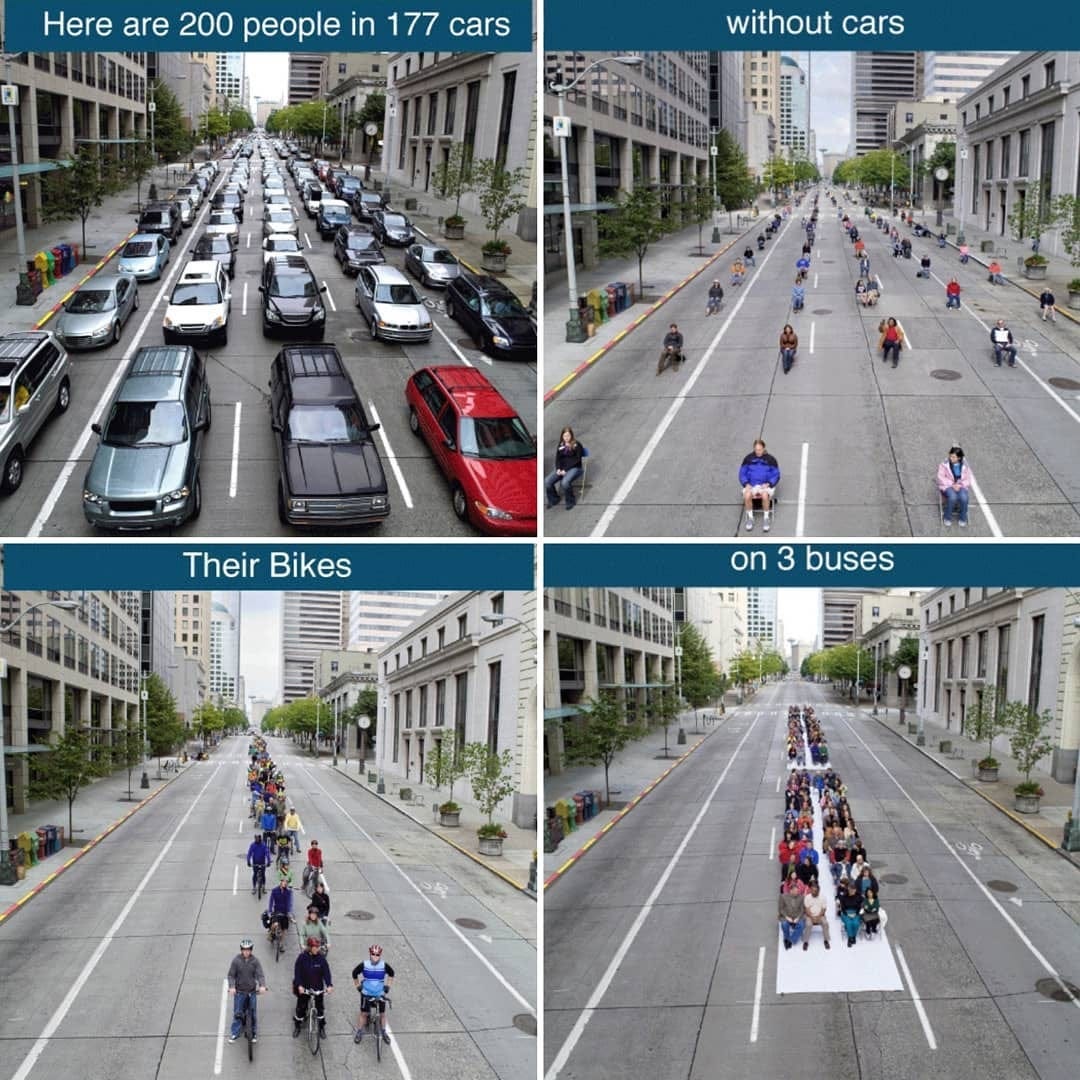
It’s easy to assume parking is just a necessary evil, but only if you assume a car is the only way to move a person from point A to point B. Public transit moves people too, and it does so much more efficiently. It’s the obvious solution when you have three thousand workers commuting onto a single campus. Our group only moved efficiently because we used two vans; if we had each driven, the trip would have collapsed under the requirement for 15+ separate spots, and someone would have inevitably gotten towed. The below image is instructive of why transit is more efficient.
This state of car dependency developed through decades of highway construction, dysfunctional transit systems, and zoning laws that mandated parking for every new building. Much of this traces back to the 1950s, when planners across Southern California began codifying minimum parking requirements based on ratios from the Institute of Transportation Engineers. Those ratios were often derived from observing suburban office parks at peak hours, essentially mandating that every building be surrounded by enough parking to handle the busiest hour of the busiest day. Today, a growing community of urbanists and abundance advocates, sometimes called Shoupistas after the UCLA professor who exposed the hidden costs of these mandates, are trying to reverse this trend. I count myself as one of them.3
Public policy can fix this without touching the companies themselves: end minimum parking requirements so industrial land is not forced into car storage, build high-throughput transit along the corridor so fewer workers have to drive, and allow more housing near job centers so commutes shrink and the parking demand never materializes in the first place. But these policies are still not yet implemented in many car-dependent cities.
One absurd example of this dynamic happened just up the road in Hawthorne, north of LAX. In 2016, SpaceX built a mile-long test tunnel for the Hyperloop adjacent to its headquarters. The prototype was supposed to demonstrate a futuristic transit system, with levitating pods hurtling through vacuum tubes at hundreds of miles per hour. In an ironic twist, SpaceX tore it down in 2022 and replaced it with a parking lot. If SpaceX can’t escape the parking trap, what chance do upcoming defense tech companies have?
Scaling the Future
One very up-and-coming company, Anduril, just announced a $1 billion expansion in Long Beach. The new campus will span 1.18 million square feet, combining office space with research and development facilities. When complete, it will employ roughly 5,500 workers on site. Matt Grimm, Anduril’s co-founder, pointed to the talent concentration in the region as a key factor, noting that the aerospace expertise around Long Beach is “truly remarkable.”
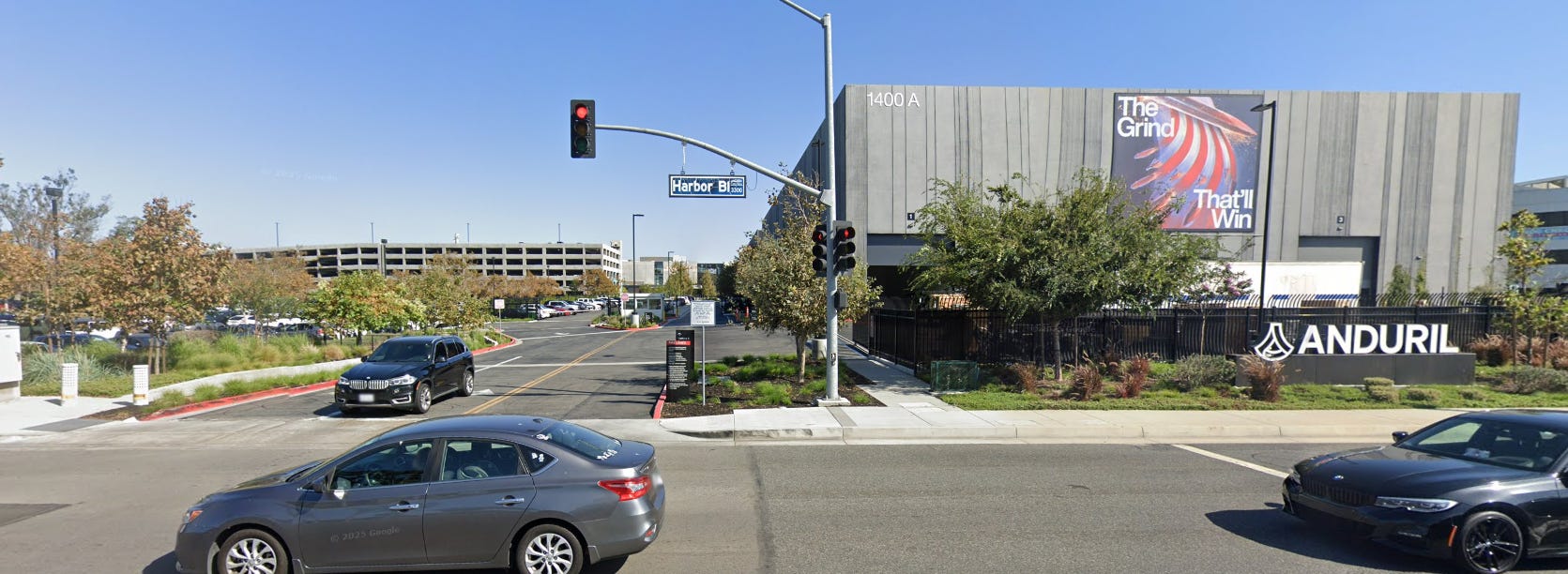
When I asked a representative from the Long Beach mayor’s office about parking, they summarized the tension of this expansion perfectly. While the city is eager for economic growth and thousands of new high-tech jobs, open land is becoming even more scarce as new development occurs. That is how it became clear to me that every aerospace company in this corridor faces the same tradeoff: factory or parking garage, manufacturing equipment or asphalt.
Solving this requires the political will to repeal outdated parking requirements and invest in the high-capacity transit and housing needed to move people without cars. None of these changes are easy, as they force local governments to prioritize industrial scale over local opposition to density. But in the end, it makes more sense to use our most valuable industrial acreage for factories, not parking.
The urban development patterns of SoCal followed us all the way to our final meeting at a corporate office in El Segundo. Our hosts explained that parking was so strict at the office that even office tenants had to pay for it. But as we drove the van into the parking garage, a security guard waved us through. He told us it was our lucky day because parking was free that evening. Our van cheered. I had spent the entire trip thinking about how parking requirements are a bottleneck on American industrial power, yet there I was, experiencing the visceral rush of free parking.
From the WGI 2025 Parking Structure Cost Outlook
Don’t quote me on this - not an aerospace engineer! I just know they are very very expensive and this is a ballpark number. https://www.voxelmatters.com/velo3d-sapphire-3d-printer-support-free/#:~:text=It%20comprises%20the%20Velo3D%20Sapphire,tag%20of%20just%20over%20$600%2C000.
For those who want to go deeper on parking, I’d recommend Strong Towns and Shoup’s book—or at least one of the summaries available online.
This is a really interesting piece. As the defense industrial base pushes for rapid expansion, sustaining such large workforces will remain a challenge without commentary like this.
With many A&D hubs (LA, Denver, and Huntsville, for this example) having lackluster public transportation, the car-to-in-person staff ratio is near one-to-one. It'll be interesting to see how Anduril deals with this issue in Long Beach. Anduril has historically pushed for 5-day in-office weeks, and I can't imagine how they'll sustain 5,500 staff without significant infrastructure on the new campus.
With respect to the Pentagon, I think they can (and most likely will) not make any changes to their parking. For one, the mystique of the Pentagon's walls would be obstructed by a huge parking structure. Not sure if this would create any additional security concerns either. Also, outside the (granted, large amount of) generals, high-ranking OSD staff, and high-profile visitors, I imagine the majority of Pentagon staffers use public transport. In the summertime, around the Pentagon metro stops, I frequently see both civilian and active military Pentagon staffers flowing in and out of the turnstiles.
While public transport might save the Pentagon from a new national parking strategy, I think the broader defense industrial base will continue to have this issue if they aren't permitted to build up.
There are always overlooked factors in everything.
Parking hadn't crossed my mind. Now it has.
Thank you for the fascinating analysis!