
Abundance for Defense
Moving from a lawyerly state to an engineering state to win the 21st-century industrial war.

This is a 3+ part series on Abundance for Defense. See the end of article for full series roadmap. Part 2 and Part 3.
The United States is trying to win a 21st-century industrial war with a governance structure designed to stop things from being built.
There is a growing chorus of smart observers who have started to notice this. Kathleen Hicks, the former Deputy Secretary of Defense, has written about bringing an abundance mindset to the Pentagon through initiatives like Replicator. Michael Purzycki has published excellent roadmaps for the kind of smart deregulation we need to fix our shipyards. There are others here and here, and one writer beat me by a day. These are necessary arguments, and in many ways they beat me to the punch. But while they are focused on the mechanics and policy outcomes, I think we need to look at the blueprints.
Two recent books, when read together, explain the deeper reason why we are losing the race so far. Abundance, of course, by Ezra Klein and Derek Thompson , argues that the U.S. has evolved into a vetocracy: a system where procedural checks, environmental reviews, and legal challenges prioritize preventing harm over building necessary housing, fixing infrastructure, and executing on innovation. Breakneck, by Dan Wang, offers the counter-image: a Chinese engineering state that empowers technocrats to mobilize capital and override objections, accepting financial waste and human cost to achieve industrial dominance.1 China is not just an abstract case study here. As the only country with a plausible claim to match or exceed American military potential, its ability to build offers a sharp point of comparison to U.S. difficulties.
Neither book is strictly about missiles or shipyards, but together they offer a way to think about the idea of Abundance for Defense. With many people discussing this concept, it’s worth being clear about what Abundance for Defense actually means as a way of seeing our problems.

The Framework
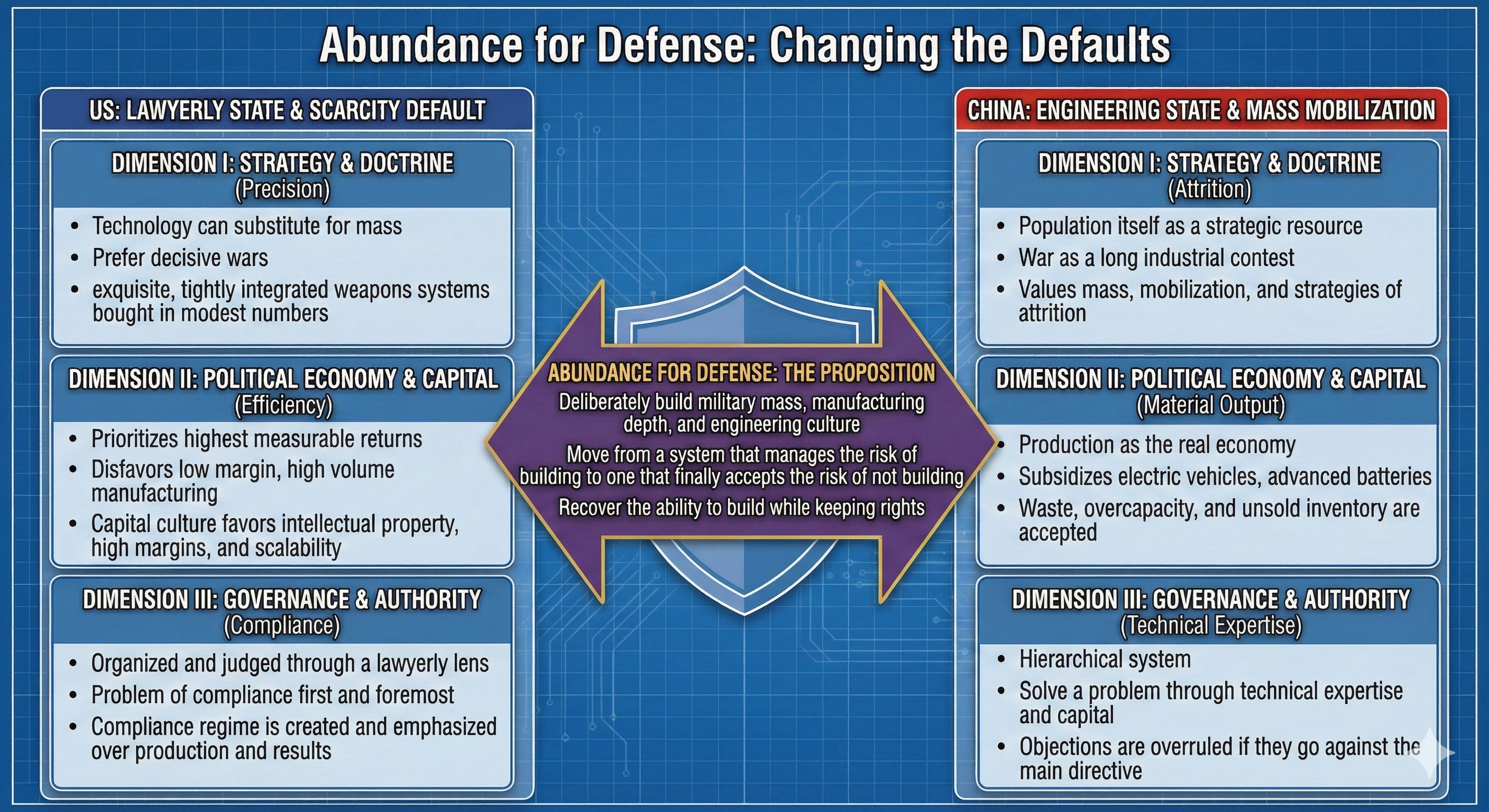
Abundance for Defense is the proposition that the United States can deliberately build the military mass, the manufacturing depth, and the engineering culture needed to match China’s industrial potential. This requires more than just a list of policy tweaks. It requires a fundamental shift in a system currently optimized for precision warfare, capital-efficient production, and lawyerly control.
This framework builds on the foundations laid by Klein and Thompson, but it seeks a deeper level of analysis than a typical policy memo. A standard proposal might focus on multi-year procurement or specific regulatory tweaks to help startups. While those are useful, they do not address the broader structural crisis. This series looks further upstream to identify why we have chosen scarcity as a default in defense. It matters because we cannot simply spend our way to a new posture. The primary constraints are found in how we imagine winning wars, how we define economic efficiency, and how our institutions manage complex public projects.
At the moment, these conversations happen in isolation. Strategic planners and the military argue over offset strategies, new concepts of operation, and attritable systems. Economists, financiers, and businesspeople debate reindustrialization and the financial returns of software over hardware in defense. Our federal government and its reformers are having a conversation about the proceduralism of administrative law and permitting. Each of these groups is describing a different part of the same elephant, yet the threads rarely connect. I’m hoping that this essay is the frame that ties these strands together.
To see those patterns clearly, we must look beyond budget line items and map the divergence between the United States and China along three linked dimensions. This first essay briefly frames this divergence. On one side is the contemporary American model, defined by precision, capital efficiency, and lawyerly authority. On the other sits the Chinese model described by Wang, defined by mass, slack, and engineering authority.
How Each Side Plans to Fight
The first dimension concerns military strategy. Since the Second World War, American leaders have been drawn to the idea that technology can substitute for mass, preferring to fight decisive wars rather than wars of attrition using technology. Nuclear weapons, precision bombing, and later the offset strategies of the Cold War encouraged a belief that superior sensors, computing, and guided weapons could compensate for smaller forces and a limited willingness to absorb casualties.2
The language of a military technical revolution and then a revolution in military affairs crystallized that view. The First Gulf War seemed to vindicate it in public, with images of clean strikes and rapid collapse. From post-Cold War interventions through the Global War on Terror, the core of American doctrine was to sense as much information as possible, move information quickly, and connect that data to exquisite weapons systems used against asymmetrically weak adversary forces.
That record was uneven in practice, but in a liberal, individualist society that prizes technological ingenuity and is acutely sensitive to casualties, this theory of victory remained attractive because it promised short campaigns and limited destruction. It also hardened institutional habits, encouraging a preference for those exquisite, tightly integrated weapons systems bought in modest numbers. These habits continue in our military acquisitions system today.3
Chinese military strategy starts from a different political and cultural history. Mao Zedong’s talk of a “Protracted People’s War” extolled the population itself as a strategic resource to be mobilized and expended. Mao was famously dismissive of nuclear coercion, suggesting that even catastrophic losses in a nuclear attack would leave China with millions of Chinese people to fight on. In conversation with Henry Kissinger, he could joke about sending the United States ten million Chinese women, which reveals a certain view of human beings as a surplus that can be used for whatever end.
The same party that spoke in those terms still commands the People’s Liberation Army, and it operates in a system that remains officially collectivist, wary of strong individual autonomy, and inclined to see material output as a core political virtue. That disposition maps more easily onto an image of war as a long industrial contest than as a sharp, high-tech military intervention.
Since the end of the Cold War, Chinese doctrine admittedly has began to aspire towards fighting shorter, high intensity local wars under “informatized” and “intelligentized” conditions in ways that echo the American military. At the same time, PLA doctrinal writings still treat a US–China conflict as something that could devolve into a war of attrition that requires endurance from Chinese society. So while the PLA is shifting to run a high tech precision military, it is still working within a strategic tradition that values mass, mobilization, and strategies of attrition moreso than the United States.4
How Each Side Pays for Power
The second dimension concerns economic systems and the differing ways societies define productive activity. In the United States, capital is allocated through a financial system that prioritizes the highest measurable returns. This creates two distinct challenges for manufacturing. In the venture capital ecosystem, which drives innovation, investors often avoid physical production because software offers infinite scalability and higher margins. As one MIT professor said, “the VCs who provided the initial financing weren’t interested in funding the manufacturing stage of the project. VCs want things that scale at zero marginal cost, which describes software, not manufacturing.” And in the broader equity markets, established manufacturing firms face intense pressure to remain capital-light while also minimizing inventory and offshoring high labor cost tasks.
When these habits spill into defense, the system disfavors the kind of low margin, high volume manufacturing required for mass at home. The mask shortage during COVID-19 is a revealing case. Faced with a basic manufacturing problem in protective gear, the United States did not respond by rapidly building out mask production at scale. Instead, we developed high-technology vaccines.5 That choice made sense inside a capital culture that favors intellectual property, high margins, and scalability. It was less well suited to the problem of building a stockpile of physical things.
On the other side of the political economy sits China. Borrowing from Dan Wang’s book, he describes China as an “engineering state,” which has consequences on economic development and finance. Senior leaders of the Communist Party are disproportionately trained as engineers and technical managers, so they naturally emphasize the importance of building infrastructure projects and manufacturing capability. This self-image draws on a developmental and Marxian tradition that treats production as the real economy, rather than finance or purely digital services, which are often portrayed as speculative or socially corrosive.
That hierarchy shapes the form of state economic management, where profit and returns are not necessarily the end goal of capital. For example, large Chinese tech companies with once-huge profits such as Didi and Ant Group have faced political investigations and regulatory campaigns, while the CCP instead subsidizes low profit electric vehicles, advanced batteries, and solar cells. This redirection of state resources is how China has created advanced manufacturing clusters in Shenzhen and technology communities of practice that lead the world — despite not making a profit. Many firms lose money or survive only with state support, and the Shanghai Composite Index has delivered poor long-term returns. But waste, overcapacity, and unsold inventory are accepted as the price of manufacturing depth.
How Each Side Builds
The third dimension concerns governance and the allocation of authority. In the United States, (again using Wang’s term) large projects are organized and judged through a lawyerly lens because the US is a lawyerly state. Legitimacy comes from demonstrating that rules and processes have been followed and that rights have been respected. Those are good things by themselves, but they also mean that Americans tend to see complex undertakings as problems of compliance first and foremost. Before anything is built, a project must collect stakeholders and follow processes, which slows things down.
Public sector program management is perhaps the greatest expression of this lawyerly state. Big public works in the US have to manage so many stakeholders, including legislatures, community groups, oversight and compliance offices, and above all, lawyers. Each round of discussions creates an additional finger in the pie, resulting in paralysis.
The program manager’s daily work often then just involves steering different people around, even if the program manager primarily wants to work on the technology and engineering problem. For the manager, the safest move is just to add more coordination and documentation instead of executing or innovating. Thus the compliance regime is created and emphasized over production and results.
China, in Wang’s account, sits at the other pole as an engineering state. It is a hierarchical system. At the top, the Politburo acts as a goal setting organization which has absolute authority to solve a problem through technical expertise and capital. Once a project is approved within the hierarchy, the main question is not process but how engineers will deliver on the goal. Unlike in the US, objections are overruled if they go against the main CCP directive, and there is much less discussion and stakeholder management in a process.
For the purposes of defense, these differing governance philosophies treat the defense industrial base differently: as either an engineering objective or a legal question. In an engineering state, a shortfall in munitions or a lack of shipyard capacity is a technical problem to be solved by calculated the right resource inputs. In a lawyerly state, the question of making more munitions has to be litigated by all parties, often preventing a quick solution. Though protecting individual rights and ensuring fair competition is important, people are realizing how much process is hurting our defense industrial base.
Changing the Defaults
These three dimensions do not tell us exactly what to build. But they show us that the manufacturing problem is complex. The strategic, financial, and legal communities are often having three different versions of the same conversation without realizing they are describing the same structural crisis. The strategist wants attritable systems, the economist wants to reindustrialize, and the reformer wants to slash red tape, yet all three are frustrated by the same architectural defaults. Abundance for defense is the frame that recognizes these are not separate issues but a single question.
How a society imagines war determines whether large-scale, replaceable capacity is a core requirement or an afterthought. How it defines economic efficiency determines whether excess industrial capacity and redundant production lines are considered strategic depth or waste. How it allocates authority over big projects determines whether new factories get treated as engineering problems or legal puzzles. If we want a defense industrial base that can survive a long war, we need to know where we sit on each of these dimensions, because those positions set the defaults.
Abundance for Defense is an attempt to change those defaults without turning into China. Our democratic, capitalist society will not get to a posture of readiness by copying the Chinese engineering state as is. But we can get there by deciding we value building our defense industrial base more than the perfect processes. We can recover the ability to build while keeping the rights that make our country worth defending. Abundance for defense is the demand to move from a system that manages the risk of building to one that finally accepts the risk of not building.
The Road Ahead
The rest of this essay series follows from this starting point.
Essay 2 sits with the American side in detail and look at how our values make it difficult for us to build Abundance for Defense.
Essay 3 will examine China, using Breakneck to unpack how an engineering, monumental state has built its current industrial position.
Essay 4 will develop an abundance for defense agenda focused on faster acquisition and cheaper mass production of useful systems.
Essay 5 will apply that framework to a specific case study, asking in each case how we can use the abundance for defense mentality to solve our problems.
I recommend both books, both a pretty easy and fast read
Gentile, Gian, Michael Shurkin, Alexandra T. Evans, Michelle Grisé, Mark Hvizda, and Rebecca Jensen, A History of the Third Offset, 2014–2018. Santa Monica, CA: RAND Corporation, 2021. https://www.rand.org/pubs/research_reports/RRA454-1.html.
Rehman, Iskander. 2022. “China, the US and Protracted War: A Comparative Evaluation.” Adelphi Series 62 (496–497): 73–132. doi:10.1080/19445571.2022.2274679.. This whole thing is worth at least a skim, I’m just basically reiterating what Rehman said.
Andrew Scobell, China and Strategic Culture (Carlisle Barracks, PA: U.S. Army War College, Strategic Studies Institute, 2002), https://press.armywarcollege.edu/monographs/822. I will say the truth here is a *bit* more complicated, and its true China is pursuing modernization by studying the US exactly - but I think they really do have this strategic culture that accepts attrition much more than the US when push comes to shove.
Lots in this section were specifically noted by Dan Wang. Read the book!
I feel like this is a misunderstanding of the purpose of US military industrial capacity. The primary objective is to maintain a minimal level of technical capacity to be able to retool should mass mobilization be required. Given the balance of powers there is not currently a need for more US mobilization. In the case of declared war, war powers would wipe out all the veto points. The military is already exempt from environmental review and similar. Government contracting could be improved, but that's not some cultural deficiency.
Very nice analysis. Looking forward to the series